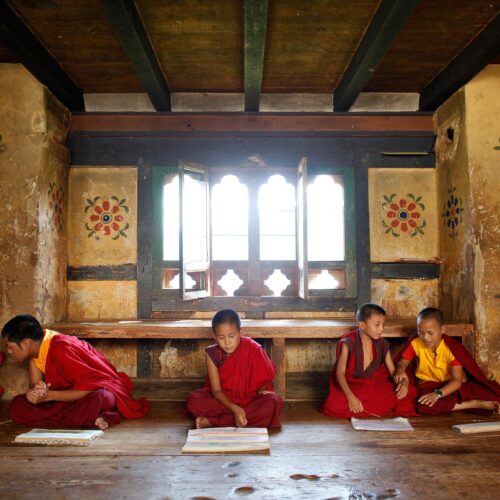
Lhuentse
Lhuentse lies in Bhutan’s far eastern mountains, a region where steep cliffs, deep river valleys and scattered hamlets create one of the kingdom’s most remote and visually striking landscapes. At its heart stands Lhuentse Dzong, dramatically perched on a rocky spur above the Kuri Chhu River, appearing almost suspended between sky and valley. Unlike more frequented dzongs, this fortress retains a profound sense of isolation and spiritual intensity, serving both as an administrative center and a monastic sanctuary deeply tied to the ancestral lineage of Bhutan’s monarchy. The surrounding villages are defined by terraced fields and stone houses that cling to mountain slopes, where daily life follows ancient rhythms shaped by terrain, weather and tradition.
Beyond its fortress landscape, Lhuentse is widely regarded as the spiritual and weaving heartland of Bhutan. In villages such as Khoma Village, artisans continue to produce the famed kushuthara textiles, intricately patterned silk weaves traditionally worn by Bhutanese women and deeply associated with identity, status and ceremony. Higher in the hills, the towering Takila Guru Statue rises as a modern spiritual landmark overlooking the valley, blending contemporary devotion with ancient Buddhist heritage. The region comes alive during the Lhuentse Tshechu, when masked dances and ritual performances gather scattered communities into the dzong courtyard, reinforcing cultural bonds across isolated settlements. Together, these elements make Lhuentse not just a destination, but a living archive of Bhutanese spirituality, textile heritage and untouched Himalayan wilderness.
Cultural
Explore the rich cultural heritage and traditions of Bhutan through immersive experiences. This activity includes visits to ancient monasteries, traditional villages, heritage sites, and local festivals. Travelers can engage with local communities, witness traditional arts and crafts, and experience authentic Bhutanese customs, cuisine, and daily life. It is perfect for those who want to understand the deep spiritual and cultural essence of Bhutan beyond its landscapes.